Autonomous Delivery Robot Road & Shoulder Operation in Europe
Lighting Homologation Requirements and Market Landscape
Audience: Autonomous Delivery Robot (ADR) CEOs, CTOs, Design & Engineering Leaders
Purpose: Clarify when lighting certification is required for an autonomous delivery robot operating at low speed on European road lanes or road shoulders—and what this means for vehicle design, homologation, and market access planning.
Pre-certified lighting benefits (internal reference for certified components and risk reduction).
Executive Context for Autonomous Delivery Robots
Across Europe, many autonomous delivery robot lighting programs are approaching a strategic fork in the road: remain sidewalk-based, or enable road and shoulder operation to scale deployments.
Once an autonomous delivery robot enters road traffic space—even at low speed—regulators increasingly evaluate it through the lens of vehicle visibility, signalling, and road safety. In this transition, lighting is often the first and most underestimated compliance gate.
1. Key Takeaway
If an autonomous delivery robot lighting system operates on public roads—whether in a traffic lane or on the road shoulder—vehicle lighting compliance is highly likely to be required.
Even at low speeds, road and shoulder operation generally triggers road-vehicle visibility and signalling requirements, meaning:
. E-marked lamps (UNECE type-approved components) are typically required for mandatory lighting functions (position lamps, direction indicators, stop lamps, etc.)
. Vehicle-level lamp installation must comply with UNECE Regulation No. 48 (R48)
When an autonomous delivery robot is permitted to operate on road lanes or shoulders, lighting is no longer just a product feature—it becomes a go/no-go enabler within the ADR’s homologation and market-access strategy.
2. Why Autonomous Delivery Robot Lighting Certification Matters
However, road and shoulder operation fundamentally changes the regulatory context for an autonomous delivery robot.
For autonomous delivery robot lighting used in road or shoulder environments, the regulatory context shifts from product safety toward vehicle-level visibility and signalling requirements.
In contrast, many autonomous delivery robot programs began on sidewalks, campuses, or controlled environments…
However, once an ADR enters road traffic space, authorities typically assess it against vehicle visibility, signalling, and road safety standards, even if the vehicle does not resemble a conventional car or truck.
Lighting becomes a compliance-critical subsystem, not an optional design choice.
3. Does the Autonomous Delivery Robot Lighting System Need Certification?
Lamps Themselves (Autonomous Delivery Robot): Yes — E-mark (UNECE Type Approval)
For road use, autonomous delivery robot lighting performing regulatory functions must generally be UNECE-approved and carry the E-mark.
Typical examples include:
. Front and rear position lamps
. Stop lamps
. Direction indicators
. Rear lamps / tail lamps
. Rear retro-reflectors
. Other light-signalling devices depending on vehicle classification
Therefore, using non-approved lamps for these functions significantly increases homologation risk and regulatory uncertainty for an autonomous delivery robot.
Vehicle-Level Autonomous Delivery Robot Lighting Installation: R48 Compliance
Even when E-marked lamps are used, the autonomous delivery robot as a complete vehicle must comply with UNECE R48 installation requirements, including:
. Mounting position and height
. Lateral spacing between left and right lamps
. Required visibility angles
. Simultaneous activation and control logic
. Warning indicators or failure logic (where applicable)
. Additional reflectors or conspicuity markings
Buying compliant lamps is necessary—but not sufficient. The integration must be homologation-ready.
4. UNECE Regulations for Autonomous Delivery Robot Lighting Homologation
The exact regulatory scope depends on whether the autonomous delivery robot is classified as an L-, M-, or N-category vehicle, a special low-speed vehicle, or a locally permitted pilot vehicle.
However, for road lighting compliance, the following UNECE regulations are foundational:
UNECE R48 — Installation of Lighting and Light-Signalling Devices
. Defines how lighting must be arranged and integrated on the vehicle
. The core vehicle-level lighting compliance regulation
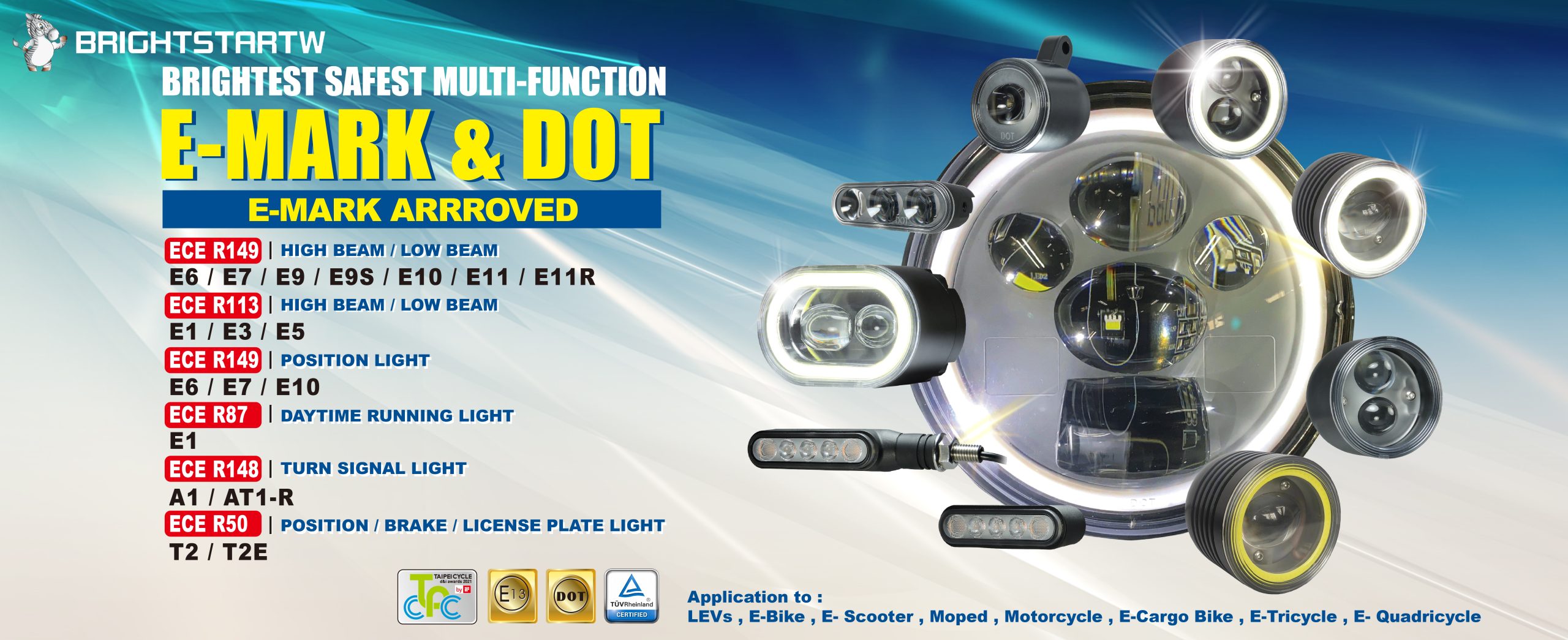
UNECE R148 / R149 / R150 — Lamp Performance and Related Devices
These newer regulations consolidate many legacy lighting standards:
. R148: Light-signalling devices
. R149: Road illumination devices (e.g. headlamps)
. R150: Retro-reflective devices and markings
R148, R149, and R150 define what an approved lamp is; R48 defines how those lamps must be installed on the autonomous delivery robot.
Outbound references (official sources):
. EU Type-Approval Framework: Regulation (EU) 2018/858 (EUR-Lex)
5. Autonomous Delivery Robot Lighting Design Decisions That Become Locked In Early
For this reason, if road or shoulder operation is part of your roadmap—even as a future option—lighting must be addressed at the concept design stage.
In practice, autonomous delivery robot lighting constraints under UNECE R48 often drive packaging and industrial design decisions earlier than expected.
R48 installation constraints strongly influence packaging, proportions, and industrial design, particularly for compact autonomous delivery robot platforms.
Design teams must decide early:
1. Which lighting functions are mandatory for the intended road behavior
2. Whether to use vehicle-grade, E-marked lighting modules (strongly recommended)
3. Mounting heights and lateral spacing (often the most restrictive factor for small ADRs)
4. Control logic: turning, braking, hazard mode, emergency behavior, night mode
5. Reflector and conspicuity strategy for low-profile vehicles
6. Environmental durability: water ingress, vibration, and thermal management
Consequently, once these parameters are fixed, late-stage changes become expensive and time-consuming.
6. Recommended Compliance Strategy for Autonomous Delivery Robot Programs
Step 1 — Define Your Regulatory Path
Path A: Road / Shoulder Operation
. Access to higher-value deployment opportunities
. Higher regulatory and homologation burden
. Typically requires a UNECE-based lighting strategy (E-marked lamps plus R48-compliant installation)
Path B: Sidewalk / Controlled Zone Operation
. Faster approvals through pilots and local permits
. Typically CE-based product safety and visibility requirements
. Full UNECE lighting homologation may not be required (depending on country and authority)
Therefore, if long-term plans include road or shoulder operation, it is usually faster and more cost-effective to design lighting correctly upfront…
7. Autonomous Delivery Robot Make-or-Buy: Why Pre-Approved Lighting Matters
From a regulatory and program-risk perspective, autonomous delivery robot lighting homologation is frequently underestimated in ADR programs.
Using lighting modules with established E-mark approvals supports ADR OEMs in three key ways:
1. Homologation Risk Reduction — Avoids the need to type-approve custom lamps from scratch
2. Faster Time-to-Market — Pre-approved components reduce homologation lead time
3. Design-for-Compliance Support — Early R48-oriented packaging guidance prevents costly redesigns
“Lighting is one of the highest return-on-investment compliance decisions for autonomous delivery robot road operation.”
Internal resources:
. Lighting product categories (internal)
. Example E-mark tail lamp (reference product) (internal)
8. Market Landscape Insight for Autonomous Delivery Robots in Europe
. The majority of real-world autonomous delivery robot deployments in Europe today remain sidewalk-based
. Road and shoulder operation remains strategically attractive but requires higher compliance maturity,
especially in visibility and signalling
. Lighting is often the first subsystem that separates pilot projects from scalable road deployment
Final Thought
For autonomous delivery robot programs aiming to move beyond sidewalks, lighting is not a cosmetic detail—it is a regulatory gateway.
The earlier lighting is treated as part of the homologation strategy, the more flexibility remains in vehicle design, deployment timelines, and European market access.
About BRIGHTSTARTW
BRIGHTSTARTW provides optical design expertise, durability engineering, and regulatory certification support for autonomous delivery robot programs and next-generation electric mobility platforms.
We help vehicle manufacturers develop compliant, high-performance lighting systems aligned with UNECE homologation requirements and European market access strategies.
📩 Contact us: [email protected]