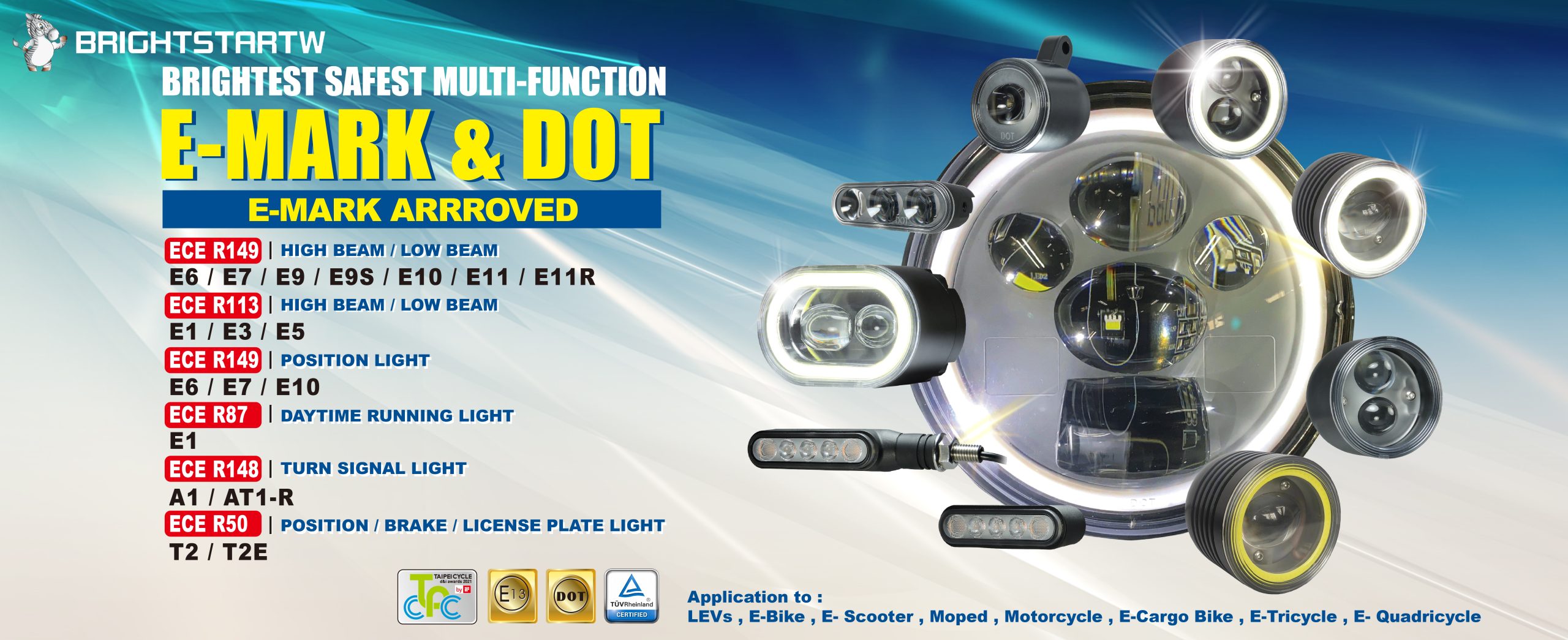
When developing electric mobility platforms for the European market—especially Germany—selecting an E-MARK tail lamp (E-MARK certified tail lamp) is not a “nice-to-have” decision.
A tail lamp is a regulated safety component that directly impacts vehicle approval timelines, product readiness, and overall market access.
For brand manufacturers and vehicle integrators, selecting an E-MARK certified tail lamp is one of the most effective ways to reduce homologation risk while maintaining engineering and design flexibility.
In this article, we explain what E-MARK means from an engineering perspective, highlight common integration gaps seen in the market, and outline how an E-MARK approved tail lamp platform creates measurable value across your product roadmap.
What Does E-MARK Certification Mean for Tail Lamps?
E-MARK is a type approval marking for automotive components under UNECE regulations.
For tail lamps, E-MARK certification confirms that the product has been evaluated against applicable regulatory requirements and is approved for use in road vehicles across Europe.
From a practical engineering standpoint, an E-MARK certified tail lamp provides:
. Verified optical performance and regulatory compliance
. Formal approval documentation (certificate and approval number)
. A reliable foundation for vehicle-level homologation workflows
For EU programs, E-MARK is not only a technical requirement—it is a key factor in reducing uncertainty and risk during time-to-market planning.
E-MARK certification is governed by UNECE vehicle lighting regulations, such as UNECE Regulation No. 50 and No. 148, which define performance and installation requirements for rear lighting devices.
. TÜV automotive lighting
. UNECE vehicle regulations
Why E-MARK tail lamp selection impacts EU vehicle approval timing
Even in well-managed vehicle programs, approval delays often originate from components that appear “minor” early in development.
Lighting systems are one of the most common examples.
Many off-the-shelf tail lamp solutions introduce integration challenges such as:
1. Limited functional scalability
Some tail lamps are designed as fixed configurations. When vehicle manufacture need to support multiple variants—different platform sizes, trim levels, or vehicle categories—the lamp becomes a constraint rather than a modular solution.
This lack of scalability can force late-stage redesigns or additional validation effort.
2. Unclear installation and integration constraints
A tail lamp may be compliant as a standalone component, but vehicle-level approval can still be affected by integration conditions, including:
. Mounting position and alignment
. Viewing angle and visibility envelope
. Vibration resistance and mechanical fixation
. Sealing robustness under real-world use
. Obstruction from racks, fenders, or license plate brackets
In short, a lamp must remain compliant after integration—not only in isolation.
3. Material limitations affecting durability and optical stability
Mass-market products are often optimized primarily for cost. Material strategy, however, directly impacts long-term reliability and appearance, including:
. UV aging and lens discoloration
. Sealing durability and impact resistance
. Optical stability and visual consistency
. Thermal management under compact packaging constraints
For brand manufacturers, these are not only engineering risks—they also translate into warranty exposure and brand reputation risk.
Engineering benefits of E-MARK tail lamp solutions
For vehicle manufacture building EU-ready e-mobility platforms, E-MARK certified tail lamps deliver value far beyond basic compliance.
Faster homologation planning and reduced re-test risk
With E-MARK type approval in place, vehicle manufacture can leverage the component’s certification package during homologation with organizations such as:
. TÜV
. DEKRA
. KBA
This significantly reduces the risk of unexpected re-testing and shortens approval timelines by removing uncertainty from the lighting portion of validation.
Improved program stability across multiple vehicle platforms
Many vehicle manufacture develop multiple platforms in parallel.
E-scooter, e-cargo, and e-bike variants often share core architecture but require different packaging, styling, and mounting conditions.
A platform-based E-MARK tail lamp solution supports:
. Faster variant expansion
. Reduced engineering redesign effort
. Better supply-chain efficiency and BOM standardization
Greater industrial design freedom without restarting compliance work
Brand differentiation matters—but customization often triggers additional validation effort.
A design-friendly, certification-ready tail lamp platform enables:
. Stronger brand identity
. Consistent visual signature across models
. Controlled customization without restarting compliance development
Higher perceived quality and long-term durability confidence
Lighting is highly visible to end users. Issues such as lens aging, discoloration, or sealing failure quickly degrade perceived product quality.
Flexible material and structural design options allow vehicle manufacture to align lighting systems with:
. Durability targets
. Environmental exposure requirements
. Premium appearance standards
This becomes a long-term advantage in both market positioning and customer satisfaction.
BRIGHTSTAR TW: E-MARK Tail Lamp Platform for EU Programs
At BRIGHTSTAR TW, we provide E-MARK type-approved tail lamps and support brand manufacturers with integration-ready engineering solutions.
Our platform highlights include:
. E-MARK type approval available
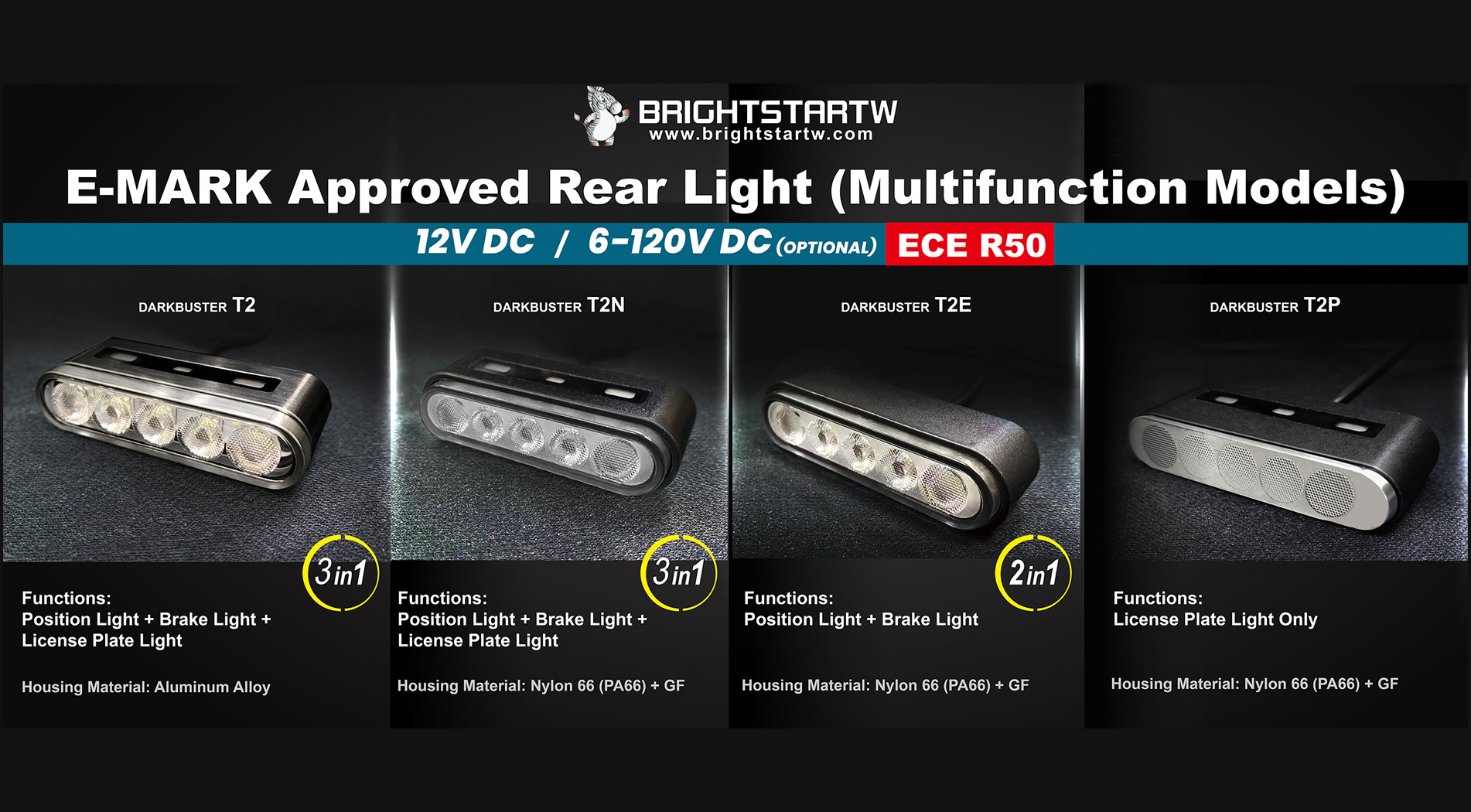
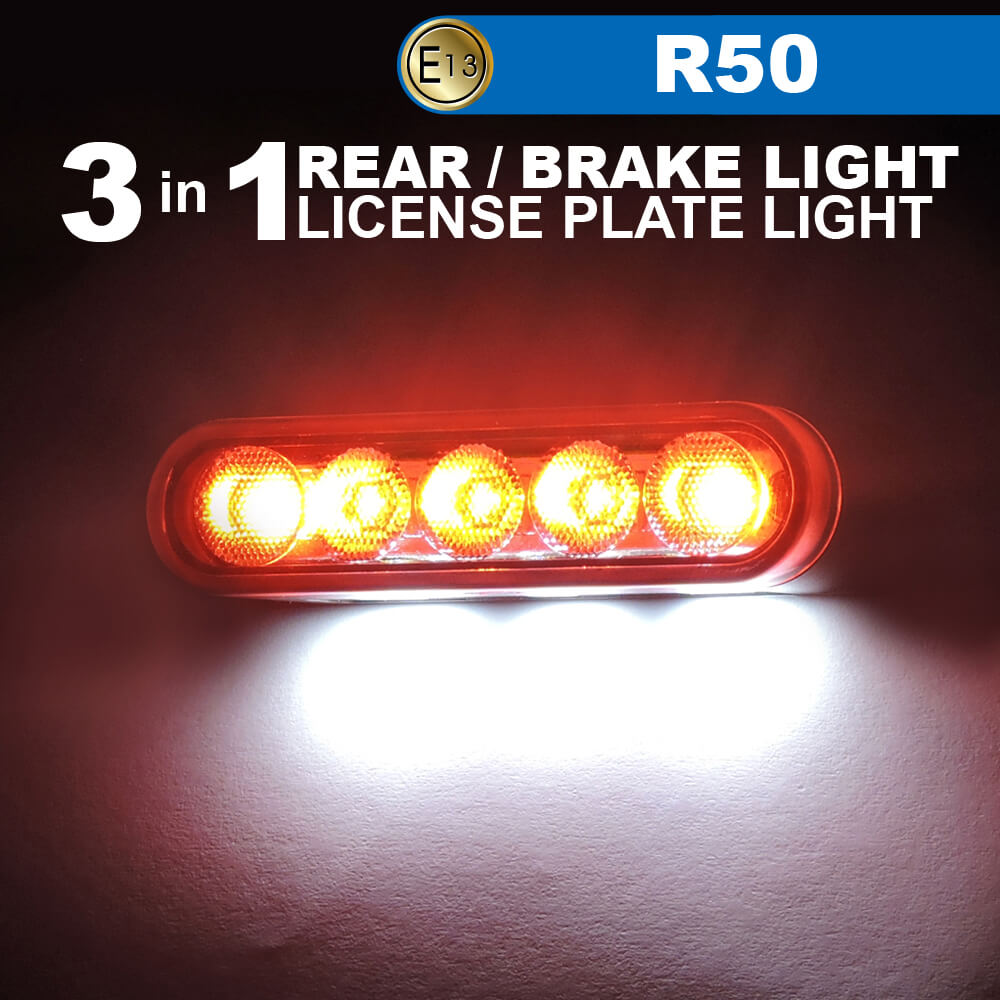
. Multi-function configurations tailored to different vehicle applications
. Multiple lens and housing material options to support durability and styling goals
Whether your program targets Germany or broader EU markets, our objective is to help vehicle manufacture accelerate validation while maintaining design flexibility and product reliability.
Conclusion: Compliance Is Only the Start—Integration Determines Success
In EU vehicle programs, an E-MARK certified tail lamp is more than a compliance checkbox.
It is a strategic engineering decision that supports:
. Faster homologation execution
. Fewer late-stage integration issues
. Stronger platform scalability
. Better long-term quality and brand perception
If you are developing EU-market e-scooter, e-cargo, or e-bike platforms and would like to evaluate an E-MARK tail lamp solution, feel free to contact us.
We can provide the certification and technical package for your engineering review.
Looking for an E-MARK certified tail lamp for EU e-mobility or autonomous vehicle programs?
Contact BRIGHTSTAR TW for certification documents and engineering support.
📩 Contact BRIGHTSTAR TW : [email protected]